
Domino Subtraction Activity: Fun Math Practice for Kids
Domino Subtraction Activity: Fun Math Practice for Kids It was a rainy Tuesday afternoon when my 8-year-old son dumped our
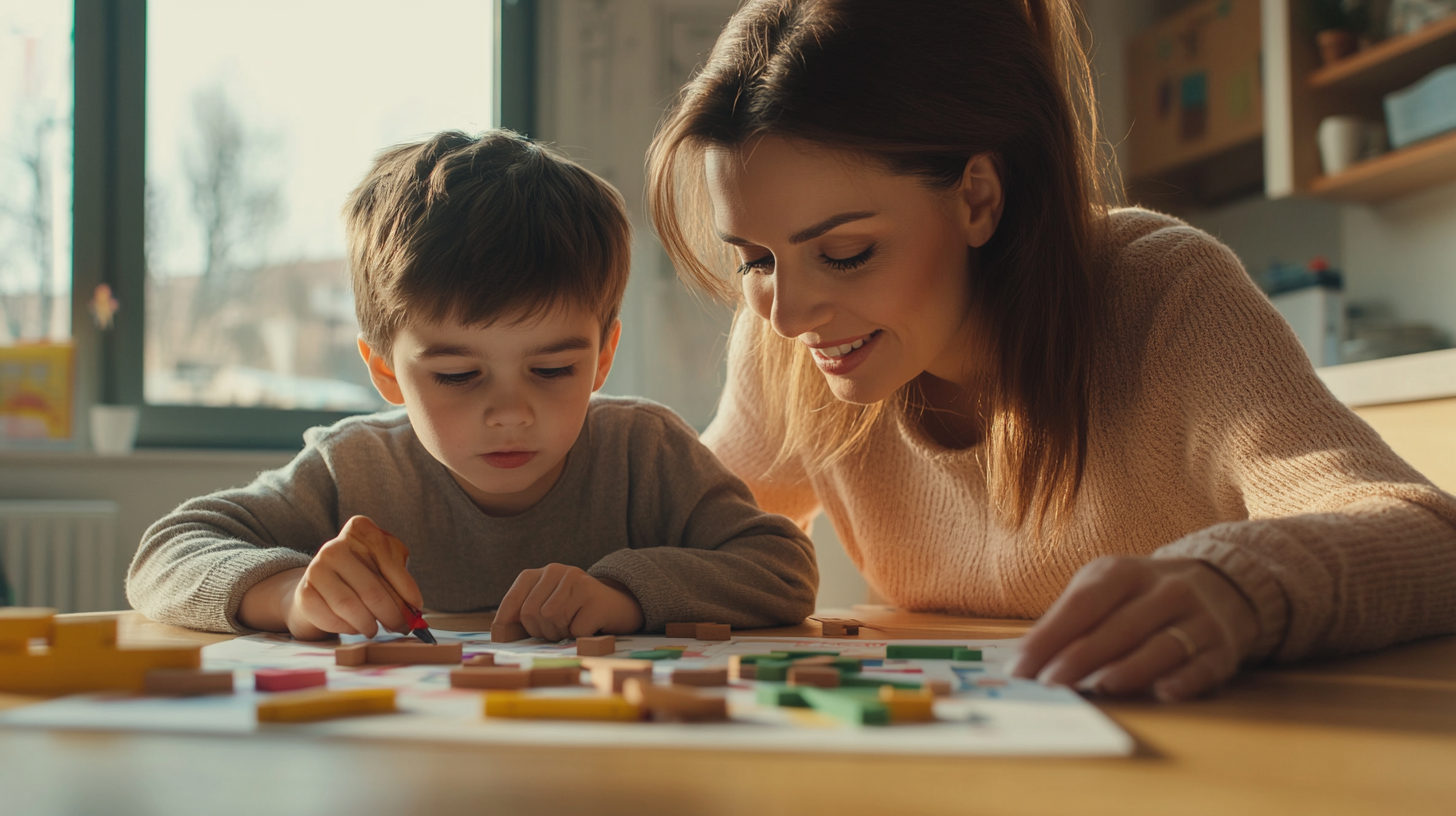
When my 8-year-old son brought home his math homework last Tuesday, he took one look at the word problems and immediately said, “This is too hard, Mom. I can’t do it.” I watched him shut down before even trying, and honestly, my heart sank a little. As a former middle and high school math teacher, I’ve seen this reaction countless times—kids giving up the moment something looks challenging. But here’s what I’ve learned both in the classroom and now as a mom: the real magic isn’t in getting the right answer quickly. It’s in building the kind of perseverance that helps kids stick with problems until they crack them. That’s exactly why I’ve become obsessed with math puzzles for kids. These aren’t your typical worksheet problems. Math puzzles for kids are like brain gyms—they’re designed to make children think differently, try multiple approaches, and most importantly, learn that struggling is actually part of learning.
My 4-year-old daughter watches her brother work through these math puzzles for kids now, and even she’s starting to understand that “I don’t know… yet” is way more powerful than “I can’t.” If you’ve ever watched your child crumble at the first sign of a challenge, or if you’re looking for ways to build genuine problem-solving skills (not just rote memorization), these five types of math puzzles for kids have genuinely transformed how my kids approach difficult tasks—and they might do the same for yours.
You know what’s fascinating? Kids are natural pattern hunters. My son can spot every Easter egg in a Marvel movie, but ask him to find the pattern in a number sequence and suddenly he’s “not good at this stuff.” That’s where Pattern Detective Puzzles come in, and they’re my absolute favorite type of math puzzles for kids to start with.
These math puzzles for kids present a sequence—numbers, shapes, or even colors—and ask kids to figure out what comes next. Here’s a simple example I used last week: 2, 4, 8, 16, ___. My son stared at it for a solid minute before his eyes lit up. “Each number is double the one before it!” he shouted. That moment of discovery? Pure gold.
But here’s where it gets interesting for building perseverance. I don’t give my kids the answer if they’re stuck. Instead, I ask questions: “What do you notice about how the numbers change?” or “Can you tell me the difference between each number?” Sometimes my daughter joins in, pointing at the numbers even though she can’t read them yet, and somehow that helps my son think differently.
The beauty of pattern puzzles is that they have multiple entry points. A child might notice the pattern by looking at differences, multiples, or even by drawing pictures. My son once drew circles to represent each number, and seeing them visually helped him crack a pattern he couldn’t see numerically.
I started with simple number patterns and gradually moved to more complex ones: 1, 1, 2, 3, 5, 8, ___ (the Fibonacci sequence—mind-blowing when he figured it out). We’ve also done shape patterns, where triangles and squares alternate in increasingly complex ways. The key is that these math puzzles for kids teach children that there’s always a rule to discover, even when it’s not obvious at first glance.
💡 Teacher Mom Tip: Create a “Pattern Detective Journal” where your child records the math puzzles for kids they solve. Let them draw the patterns, write the rules they discover, and even rate how tricky each one was. This creates a visual record of their perseverance journey and shows them how much they’ve grown.
Do you ever feel like your kids guess randomly instead of thinking things through? I noticed this with my son during homework—he’d just throw out answers hoping one would stick. That’s when I introduced him to logic grid math puzzles for kids, and honestly, they’ve been game-changing for his approach to problem-solving.
Logic grid puzzles are those wonderful brain-teasers where you’re given a set of clues and have to figure out how different elements match up. Think: “Sarah isn’t wearing the red dress. The girl in blue likes vanilla ice cream. Emma doesn’t like chocolate…” Your child has to use pure deductive reasoning to solve who’s wearing what and who likes which flavor.
What I love about these math puzzles for kids is that they force systematic thinking. My son can’t just guess—he has to track what he knows, what he’s eliminated, and what’s still possible. I started him with simple 2×2 grids (just two categories to match) and watched him develop his own system of checking off possibilities.
Last month, we did a puzzle where three kids went to different parks on different days. The clues seemed contradictory at first, and I watched my son’s frustration build. But instead of giving up like he used to, he grabbed colored pencils and started marking his grid. “If Tom didn’t go on Monday, and the park visit on Monday wasn’t the beach, then…” He talked himself through it, step by step, until suddenly everything clicked into place. The pride on his face was absolutely worth it.
These math puzzles for kids teach children that complex problems need organized approaches. They learn to break big challenges into smaller, manageable pieces—a skill that transfers to everything from multi-step math problems to science projects. Even my daughter gets involved by helping “check” if the answers make sense when we read them back.
I print age-appropriate logic grids from puzzle websites (there are tons of free resources), and we tackle them during weekend breakfast. Starting with three items to match is perfect for beginners. As confidence builds, we’ve moved to 4×4 grids with more complex clues.
💡 Teacher Mom Tip: Don’t rescue your child too quickly when they’re stuck on math puzzles for kids. Instead, ask: “What do you know for sure?” and “What can you eliminate?” These questions teach them to use what they’ve already figured out as stepping stones to the next discovery. Give them time to struggle productively—that’s where the real learning happens.
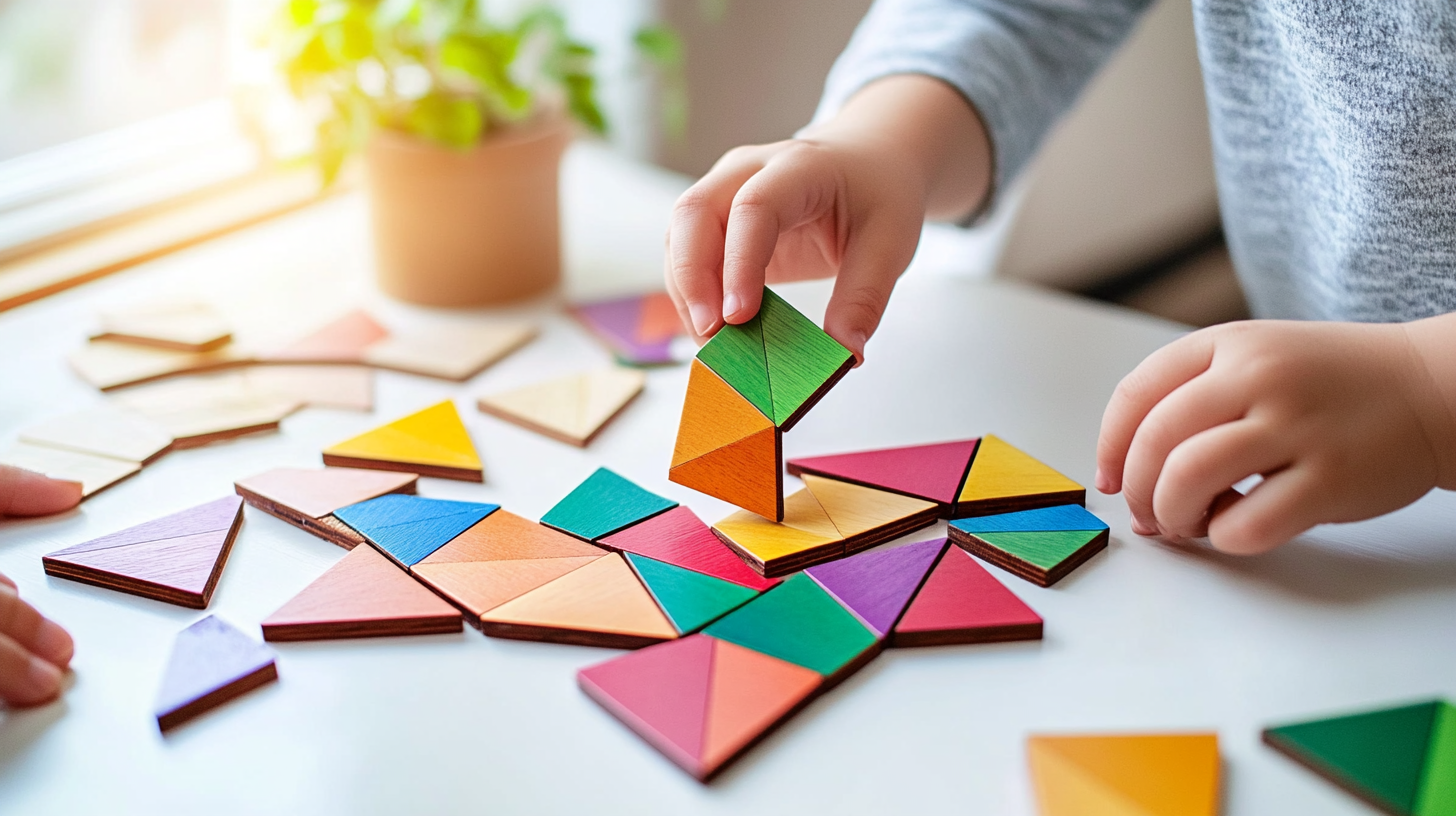
Here’s something I didn’t expect: my daughter, who just turned 4, absolutely loves tangrams. These ancient Chinese math puzzles for kids use seven geometric pieces to create specific shapes, and they’re brilliant for building spatial reasoning and perseverance simultaneously.
If you’re not familiar, tangrams are like sophisticated shape puzzles. You get seven pieces—triangles of various sizes, a square, and a parallelogram—and you’re challenged to arrange them to match a silhouette. Sounds simple, right? But here’s the catch: every piece must be used, they can’t overlap, and often the solution requires rotating or flipping pieces in ways that aren’t immediately obvious.
I bought a wooden tangram set three months ago, and it’s become our go-to activity when the kids need a break from screens. What I love is watching their brains work differently than with paper-and-pencil math. My son approaches these math puzzles for kids methodically, testing each piece systematically. My daughter? She goes by intuition and feeling, spinning pieces until something “looks right.” Both approaches work, and they’re learning from each other.
The perseverance piece is huge here. There’s something about manipulating physical pieces that makes kids more willing to try again. When my son’s third attempt didn’t work, instead of melting down, he just swept the pieces aside and started over. “I think the big triangle needs to go this way,” he muttered to himself. That kind of resilient problem-solving? That’s exactly what we’re after.
We started with simple shapes—a house, a boat, a cat—and moved to more complex challenges. Now we’re working on math puzzles for kids where they don’t show you the internal lines, just the overall silhouette. These are genuinely difficult, and honestly, sometimes I struggle with them too. But I let my kids see me persist, and I think that modeling matters.
Tangrams also sneak in valuable geometry concepts. My son started recognizing that triangles can be combined to make squares, or that rotating a parallelogram changes how it fits. These spatial transformation skills are foundational for higher-level math, but right now, he just thinks he’s solving cool puzzles.
💡 Teacher Mom Tip: When your child solves a tangram from our collection of math puzzles for kids, have them trace around it and create a challenge for someone else. My kids make puzzles for each other (and for me), which reinforces their understanding and gives them ownership of the learning process. Plus, creating puzzles is even more cognitively demanding than solving them!
“I’m thinking of a number. When you multiply it by 3 and add 5, you get 20. What’s my number?” I posed this riddle to my son during our drive to soccer practice last week, and I could practically see the gears turning in his head. Number riddles are sneaky brilliant math puzzles for kids because they don’t feel like math homework—they feel like mysteries to solve.
Unlike straightforward computation problems, number riddles require kids to work backward, think flexibly, and often use trial and error strategically. They’re perfect for building perseverance because there’s an inherent curiosity factor. Kids want to crack the code.
I’ve found that starting with simpler math puzzles for kids builds confidence. “I’m a two-digit number. My tens digit is three more than my ones digit, and my digits add up to 9. What number am I?” My son started guessing randomly at first—”Is it 45? 72?”—but I guided him to be more systematic. “Let’s think about which pairs of numbers add to 9,” I suggested. Once he listed them out (0&9, 1&8, 2&7, 3&6, 4&5), checking the “three more” condition became manageable. “It’s 63!” he finally declared.
What I love is how these riddles teach algebraic thinking without the formal notation. Kids learn to hold information in their heads, test hypotheses, and revise their thinking based on what does or doesn’t work. These are executive function skills disguised as fun.
I keep a running list of number math puzzles for kids on my phone, and I pull them out during transitions—waiting at the dentist’s office, stuck in traffic, or during dinner when the conversation lulls. My daughter can’t solve them yet, but she loves making up her own “riddles” (“I’m thinking of pink!”), and I play along because she’s developing the same questioning mindset.
We’ve also started creating math puzzles for kids for each other, which is even more cognitively demanding. My son has to think about what makes a good clue—specific enough to have one answer, but challenging enough to require thinking. His first attempt was too easy (“I’m a number between 5 and 7”), but he’s getting better at crafting genuinely tricky riddles.
💡 Teacher Mom Tip: Introduce the strategy of working backward when solving math puzzles for kids, which is powerful for both riddles and life. If we know the end result (20) and what operation happened (multiply by 3, add 5), we can reverse it (subtract 5 to get 15, divide by 3 to get 5). This “undo” thinking is a fundamental problem-solving strategy that applies everywhere from math to planning their day backward from bedtime.
I’ll be honest—matchstick math puzzles for kids nearly broke me the first time I tried one. But watching my son wrestle with them (and eventually triumph) has been one of my proudest parenting moments. These puzzles present an arrangement of matchsticks forming shapes or equations, and challenge you to move a specific number of sticks to create something new.
For example: You have matchsticks arranged to show “6 + 4 = 4” (which is obviously wrong). Can you move just one matchstick to make the equation correct? The answer isn’t immediately obvious, and that’s exactly the point. These math puzzles for kids require out-of-the-box thinking, visual-spatial skills, and serious perseverance.
My son’s first matchstick puzzle took him nearly 20 minutes. I watched him move sticks, get frustrated, put them back, try different configurations, and nearly give up three times. But I held back from helping (SO hard for a teacher mom!), and when he finally saw the solution—moving one stick from the plus sign to make it “5 + 4 = 9″—his whoop of joy scared our dog.
What makes these puzzles special is the constraint element. Kids can’t add new pieces or take pieces away (usually)—they have to work within strict limitations. This teaches flexible thinking within boundaries, which is honestly a life skill. How often do we all have to solve problems with limited resources?
I use actual matchsticks (with the striking ends cut off for safety) because the tactile element helps with these math puzzles for kids. Both my kids benefit from physically moving pieces rather than just imagining the moves. We’ve done shape puzzles too—”Move two matchsticks to turn this arrangement of four squares into three squares”—which require serious spatial reasoning.
The perseverance aspect here is remarkable. Because the puzzles are physical and visual, kids can see their attempts, learn from them, and try again without the fear of “messing up” a paper. My son’s developed a strategy of taking a photo of the original puzzle so he can reset if needed—smart kid!
We’ve made matchstick math puzzles for kids a Sunday afternoon tradition. I print new challenges from online sources (there are hundreds of free puzzles available), and we race to solve them—though honestly, my kids often beat me, which is fantastic for their confidence.
💡 Teacher Mom Tip: When your child is truly stuck on math puzzles for kids, try asking “What if we focus on just one small part?” For matchstick puzzles, this might mean: “Let’s just look at this corner—what could we create here?” Breaking overwhelming problems into tiny, manageable pieces teaches a problem-solving approach that works for everything from tough math to big life decisions.
Here’s what I’ve learned after six months of making math puzzles for kids a regular part of our family routine: consistency matters more than intensity. We don’t do puzzles for hours every day. Instead, we weave them into normal moments—breakfast table challenges, car ride brain-teasers, weekend puzzle tournaments where the winner gets to choose dessert.
The transformation I’ve seen in my son isn’t about math skills (though those have definitely improved). It’s about his entire approach to challenge. He used to shut down at the first sign of difficulty. Now? He literally said to me last week, “This is tricky, but I can figure it out if I keep trying.” That sentence alone makes every puzzle worth it.
My daughter is absorbing these lessons too, even at 4. She watches her brother persist, sees me struggle and keep going, and she’s learning that hard things are just things we haven’t figured out yet. These math puzzles for kids aren’t really about math at all—they’re about building brains that don’t quit.
If you’re wondering where to start with math puzzles for kids, begin with whatever sparks your child’s interest. Does your kid love stories? Try logic puzzles with narrative elements. More of a hands-on learner? Start with tangrams. The puzzle type matters less than the habit of engaging with challenges regularly and viewing struggle as normal, even desirable.
And here’s something wonderful: these math puzzles for kids are screen-free, affordable (many are completely free online), and portable. We’ve done matchstick puzzles on an airplane, pattern puzzles in a restaurant, and number riddles during a power outage. They’re the perfect combination of educational and genuinely fun.
👉 More daily math play ideas here
The best part? You don’t need to be a math teacher to facilitate these math puzzles for kids. You just need to create space for your children to struggle productively, ask guiding questions rather than giving answers, and celebrate both the victories and the valuable failures. Because honestly, the puzzle that takes 45 minutes and involves multiple failed attempts? That one teaches way more than the puzzle they solve in 30 seconds.
When I look back at my teaching career, I realize the students who succeeded weren’t always the ones who got answers fastest. They were the ones who kept trying. That’s what math puzzles for kids build—not just math skills, but the character trait that determines success in every area of life: perseverance.
What age should kids start doing math puzzles?
Kids can start engaging with simple math puzzles for kids as early as preschool (ages 3-4) with basic pattern recognition and shape puzzles like tangrams. The key is choosing age-appropriate challenges—simple patterns and hands-on math puzzles for kids for younger children, and more complex logic puzzles and number riddles for elementary-aged kids. My 4-year-old daughter enjoys tangrams and basic pattern games, while my 8-year-old son tackles logic grids and challenging matchstick math puzzles for kids. Start where your child is and gradually increase complexity as their confidence grows.
How do math puzzles help with school math if they’re not practicing arithmetic?
This is a question I get from parents all the time! Math puzzles for kids build the foundational thinking skills that make all math easier—logical reasoning, pattern recognition, spatial awareness, and most importantly, perseverance through difficulty. When my son faces a challenging word problem in school now, he has strategies for breaking it down and doesn’t give up immediately. The problem-solving approaches learned through math puzzles for kids transfer directly to academic math, often more effectively than drilling arithmetic facts. Plus, puzzles keep kids’ relationships with math positive, which is invaluable for long-term success.
What if my child gets frustrated and wants to give up on a puzzle?
Frustration is actually a sign the math puzzles for kids are working! The goal isn’t to eliminate struggle but to help kids push through it productively. When my son gets frustrated with math puzzles for kids, I acknowledge his feelings (“This is really tricky, isn’t it?”), remind him of puzzles he’s solved before (“Remember how hard the tangram cat seemed at first?”), and offer strategic hints rather than answers (“What do you know for sure? What can you eliminate?”). Sometimes taking a break and returning with fresh eyes helps too. The key is teaching that frustration is temporary and solvable, not a stop sign. That lesson alone is worth every moment of struggle.
Building a brain that doesn’t quit starts with one puzzle, one attempt, one moment of choosing to try again.
Ready to transform math time from dreaded homework to exciting brain challenges your kids actually ask for? Discover more engaging math puzzles for kids and downloadable puzzle sets in our free parent guide—grab your copy now and watch your child’s confidence soar as they tackle challenges with genuine excitement! Your journey to raising resilient problem-solvers starts with just one puzzle today.
Domino Subtraction Activity: Fun Math Practice for Kids It was a rainy Tuesday afternoon when my 8-year-old son dumped our

Dice Games for Multiplication: Fun Math Play Kids Enjoy As a former middle and high school math teacher turned mom

Money Math at the Farmers Market: 7 Fun Ways Kids Learn Value Last Saturday morning, I watched my 8-year-old son
*Also read:
25 Brilliant LEGO Math Activities to Build Number Sense and STEM Skills at Home
Teach Kids to Tell Time: The Clock Game Every Parent Should Try at Home