

Perseverance with Math Puzzles: Building Grit & Number Sense
5 Fun Math Puzzles for Kids to Build Perseverance & Focus When my 8-year-old son brought home his math homework

It was a rainy Tuesday afternoon when my 8-year-old son dumped our box of dominoes on the kitchen table and asked, “Mom, can we play a game?” I was about to suggest the usual domino tower building when a lightbulb went off in my teacher brain. What if we turned these simple tiles into a hands-on math lesson? That’s how our favorite domino subtraction activity was born, and let me tell you—it transformed the way my kids approach subtraction. As a former middle and high school math teacher who now spends her days with an energetic 8-year-old boy and a curious 4-year-old daughter, I’ve learned that the best math practice doesn’t feel like work at all. The domino subtraction activity we discovered that day has become our go-to solution whenever I hear those dreaded words: “Math is boring!”
If you’ve ever watched your child struggle with subtraction facts or simply zone out during worksheet time, you’re not alone. The traditional drill-and-kill approach rarely works for young learners who need to see, touch, and manipulate concepts to truly understand them. That’s exactly why domino-based math activities are absolute game-changers for elementary-age children.
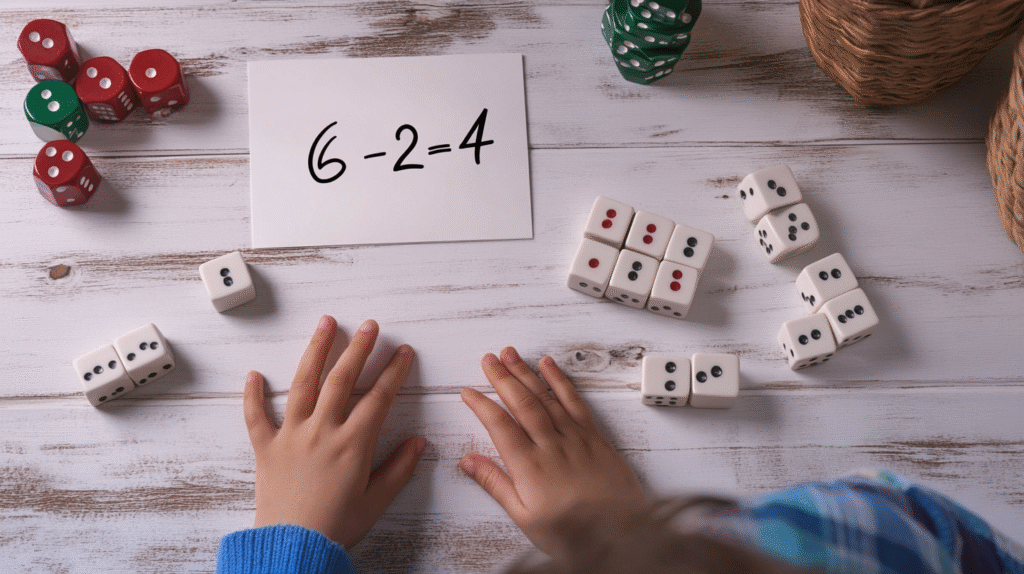
Do you ever notice how your kids can spend hours building with blocks or sorting toys, but five minutes of math practice feels like pulling teeth? There’s a reason for that. Children learn best when they can physically interact with mathematical concepts, and dominoes offer the perfect tactile experience for understanding subtraction.
When I taught high school algebra, I saw countless students who never truly grasped basic operations because they’d only memorized procedures without building number sense. Dominoes change that entire dynamic. Each tile is divided into two sections with dots that kids can count, compare, and manipulate. This visual representation makes abstract subtraction problems concrete and manageable.
The beauty of a domino subtraction activity lies in its simplicity. Your child isn’t staring at numbers on a page trying to remember which direction to “borrow” or “carry.” Instead, they’re looking at actual quantities they can count with their fingers. My daughter, who just turned 4, can participate alongside her older brother because she can count the dots even though she can’t read subtraction equations yet.
Research in early childhood mathematics education consistently shows that manipulatives—physical objects kids can handle—significantly improve both understanding and retention. Dominoes are manipulatives that most families already have at home, which means you don’t need to invest in expensive educational materials to give your children quality math practice.
Here’s what makes dominoes particularly effective for subtraction: they naturally present two numbers side by side, which mirrors the structure of a subtraction problem. When you place a domino with 6 dots on one side and 2 dots on the other, you’re looking at “6 – 2” without any additional setup. Your child can physically cover up the smaller number of dots and count what remains, making the answer tangible rather than abstract.
During my teaching years, I watched students light up when they finally understood a concept they’d been struggling with for weeks. That same spark happens at my kitchen table now when my son solves a challenging subtraction problem using dominoes. He’ll pump his fist in the air and say, “I got it, Mom!”—and that confidence carries over into his regular schoolwork.
💡 Teacher Mom Tip: Start your domino subtraction activity by letting your child simply explore the dominoes first. Let them sort by color, count all the dots, or build patterns. This free play builds comfort with the materials and naturally develops counting skills that support subtraction.
Creating a dedicated math activity space doesn’t require a Pinterest-perfect playroom or expensive supplies. In fact, some of our best learning happens at our regular kitchen table with nothing more than a standard set of dominoes and a few household items. The key is making the setup inviting and accessible so your kids actually want to engage with the domino subtraction activity.
I keep our dominoes in a clear container on a low shelf where both my kids can reach them independently. This small detail matters more than you might think—when children can access materials themselves, they’re more likely to initiate learning activities on their own. Just last week, my son grabbed the dominoes before breakfast and started working on subtraction problems while I was making pancakes.
For your basic setup, you’ll need a standard double-six domino set (that’s the type that goes up to six dots on each side). If you have a larger set with more dots, that’s fine too—you’ll just have more variety for practicing larger numbers. I also keep a small basket with these additional items nearby: a whiteboard and dry-erase marker for writing equations, a handful of small counters or coins for extra manipulatives, and a kitchen timer for adding a fun challenge element.
The physical space matters too. Clear off enough table or floor space so dominoes can be spread out and organized. My kids like to sit on the floor with dominoes spread around them, which gives them room to sort and create different problem types. Sometimes we work at the table if we’re incorporating writing practice, but the floor offers more freedom for kinesthetic learners who need to move while they think.
Lighting might seem like a minor detail, but good lighting helps kids see the dots clearly without eye strain. We do our domino subtraction activity near the kitchen window during the day or under our dining room light in the evening. My daughter sometimes counts incorrectly when she’s squinting at dominoes in dim light, so proper illumination really does make a difference.
One setup strategy that works beautifully is creating “subtraction stations” with different difficulty levels. I’ll place a group of dominoes with smaller numbers in one area for my 4-year-old and dominoes with larger numbers in another area for my 8-year-old. This way, both kids can work on age-appropriate problems at the same time without feeling like one activity is too easy or too hard.
Ask your child: How would you like to organize the dominoes? Should we sort them by total number of dots, by color, or just mix them all together? Giving kids ownership over the setup process increases their investment in the activity.
💡 Teacher Mom Tip: Create a simple visual guide showing how to set up the domino subtraction activity and post it at your math station. Include pictures or drawings of the steps: (1) Choose a domino, (2) Identify the larger number, (3) Count backwards or cover dots, (4) Find the answer. Even pre-readers can follow picture-based instructions, building independence.
The magic of dominoes is their versatility—you’re not stuck doing subtraction just one way. I’ve developed five different approaches to our domino subtraction activity that keep things fresh and match different learning styles. Some days my son prefers the competitive race format, while other days my daughter wants the quiet, methodical sorting approach.
Method 1: The Classic Subtraction Setup
This is the simplest introduction to domino-based subtraction. Place a domino horizontally in front of your child with the larger number on the left (this matches the way we write subtraction problems). Have them count the dots on the left side, then count the dots on the right side, and finally figure out the difference. For example, if they have a domino showing 6 dots and 2 dots, they’re solving 6 – 2 = 4.
My daughter loves this method because she can use her fingers to cover up the smaller group of dots and count what’s left. It makes the “taking away” concept extremely concrete. We often start here on days when she needs a confidence boost or when we’re introducing subtraction to a child who’s new to the concept.
Method 2: The Equation Writing Challenge
This approach works perfectly for kids who are ready to connect physical manipulatives to symbolic notation. After your child determines the difference between the two sides of a domino, have them write the complete equation on a whiteboard or paper. So that 6 and 2 domino becomes “6 – 2 = 4” in written form.
My son particularly enjoys this method because it feels more “grown up” and resembles what he does in his school math work. I’ve noticed his number writing has improved significantly since we started incorporating this writing component into our domino subtraction activity. The back-and-forth between hands-on manipulation and symbolic representation strengthens both his conceptual understanding and his procedural fluency.
Method 3: The Speed Round
Kids who thrive on competition and timed challenges love this version. Set a timer for two minutes and see how many domino subtraction problems your child can solve correctly before time runs out. They flip a domino, quickly determine the difference, and move to the next one.
I track my son’s progress on a simple chart, and he’s motivated by beating his previous records. Just yesterday he solved 23 problems in two minutes—a huge improvement from the 12 he could do when we started a few months ago. This speed element helps develop automaticity with subtraction facts, which is crucial for higher-level math success later.
Method 4: The Sorting Game
This method combines categorization skills with subtraction practice. Have your child work through the entire domino set, solving each subtraction problem and then sorting the dominoes by answer. All the dominoes with a difference of 1 go in one pile, all those with a difference of 2 in another pile, and so on.
My 4-year-old daughter particularly loves this version because it feels like a sorting game rather than “math work.” She gets practice with subtraction while also developing organizational and classification skills. When she’s done, we count how many dominoes are in each pile, which adds in counting practice too.
Method 5: The Story Problem Creator
This advanced version helps kids connect abstract subtraction to real-world scenarios. After solving a domino subtraction problem, have your child create a story that matches the equation. For a domino showing 5 dots and 3 dots, they might say, “I had 5 cookies and I ate 3 of them. Now I have 2 cookies left.”
This approach builds the critical thinking skills that standardized tests assess—the ability to translate between different mathematical representations. When my son creates these stories, I can see his brain making connections between the physical dominoes, the numbers, and real-life situations where subtraction happens naturally.
👉 More daily math play ideas here
💡 Teacher Mom Tip: Rotate through these five domino subtraction activity methods throughout the week rather than using the same approach every day. Variety keeps kids engaged and ensures they develop both computational fluency and conceptual understanding. Monday might be speed rounds, Wednesday could be sorting day, and Friday might be story problem time.
One of my favorite aspects of domino-based math is how easily it scales for different developmental stages. The same set of dominoes that my 4-year-old uses for basic counting becomes a tool for my 8-year-old to practice mental math strategies. This flexibility means you can use the domino subtraction activity with multiple children simultaneously, even if they’re years apart in age or ability.
For Preschoolers and Kindergarteners (Ages 3-5):
At this stage, focus on pre-subtraction skills that build the foundation for later success. Have your young learner simply count the dots on each side of the domino and identify which side has more. This comparison skill (“more than” and “less than”) is essential before formal subtraction makes sense.
My daughter started working with dominoes when she was 3, and we spent months just playing with them before introducing any subtraction concepts. She’d sort them by color, count the total dots on each tile, and make patterns. When she showed solid one-to-one correspondence counting (touching each dot while saying a number), we moved to simple taking-away activities.
For a gentle introduction to subtraction, use dominoes with small numbers only—stick with tiles where both sides show between 1 and 3 dots. Have your child count the dots on the larger side, then physically cover the dots on the smaller side with their thumb or a small toy. Ask, “How many dots can you still see?” This concrete action of covering and revealing makes the taking-away process visible and understandable.
For Early Elementary (Ages 5-7):
Children in this age range are typically ready for more formal domino subtraction activity practice. They can handle dominoes with larger numbers and are beginning to memorize basic subtraction facts. This is the perfect time to introduce the equation-writing component.
Start each session by having your child choose 5-10 dominoes randomly. For each one, they’ll identify the larger number, subtract the smaller number, and write the equation. My son’s first-grade teacher actually recommended this exact practice when he was struggling with subtraction facts, and she was thrilled to hear we were already doing it at home.
At this stage, you can also introduce the concept of subtraction as “finding the difference.” Instead of thinking about subtraction as taking away, kids learn to see it as comparing two quantities. A domino with 6 dots and 4 dots can be viewed as “How much more is 6 than 4?” rather than “6 take away 4.” This comparison interpretation of subtraction becomes incredibly important in later mathematics.
For Upper Elementary (Ages 8-10):
Older elementary students can use the domino subtraction activity to develop mental math strategies and fluency with larger numbers. Challenge your child to solve problems without counting individual dots—they should be able to recognize dot patterns instantly and calculate differences mentally.
My 8-year-old son now uses dominoes to practice compensation strategies. For example, if he has a domino showing 6 and 4, instead of counting, he might think, “6 minus 4 is the same as 5 minus 3, which is 2.” He’s applying number sense strategies to make subtraction easier, which is exactly what we want at this age.
You can also introduce multi-step problems using two or more dominoes. For instance, “Find the difference on each of these two dominoes, then subtract those two answers from each other.” This kind of problem requires holding multiple steps in working memory while applying subtraction skills—excellent practice for the complex math they’ll encounter in middle school.
For Children Who Need Extra Support:
Some kids need more time with concrete materials before they’re ready for abstract subtraction problems. If your child is struggling, slow down and spend more time on the foundational skills. Use just a few dominoes with very small numbers, and let your child take as much time as they need to count each dot.
I’ve worked with many students over the years who needed significant scaffolding with basic operations. The key is patience and never rushing to the next level before the current level is solid. If your child is guessing or getting frustrated, that’s a sign to back up and simplify. Maybe they need to work with dominoes that only have 1-3 dots on each side for several weeks before progressing to larger numbers.
Consider using additional manipulatives alongside the dominoes. Place out a pile of small counters (buttons, coins, or dried beans work great) and have your child build the domino pattern with counters too. They can physically remove counters to match the subtraction problem, which provides an extra layer of concrete experience.
💡 Teacher Mom Tip: Create a simple assessment system to track your child’s progress with the domino subtraction activity. Every few weeks, time how many problems they can solve accurately in two minutes, or note which number combinations they solve instantly versus which ones require counting. This progress monitoring helps you know when they’re ready to advance to more challenging variations.
The ultimate goal of any math practice isn’t just to get right answers on worksheets—it’s to develop problem-solving skills that transfer to real life. This is where the domino subtraction activity truly shines, because it opens doors to countless extensions that connect mathematical thinking to everyday situations your kids already encounter.
One of my favorite extensions is the “shopping trip” scenario. After your child has practiced basic domino subtraction, set up a pretend store using household items. Each item has a price represented by domino dots. Your child starts with a certain number of coins (we use pennies), buys an item by giving you the number of coins shown on one side of a domino, and then figures out how much change they should receive based on the other side of the domino.
This scenario brings subtraction into a context kids understand—spending money and getting change back. My son loves being the customer and carefully counting his change to make sure I gave him the right amount. We’ve had fantastic conversations about money management, making choices about what to “buy,” and even addition practice when he wants to buy multiple items.
Another powerful extension involves measurement and time. Use dominoes to create subtraction problems about durations. “You watched TV for 6 episodes (show the side of the domino with 6 dots), but you were supposed to watch only 2 episodes (show the 2-dot side). How many extra episodes did you watch?” This connects subtraction to time management and rule-following in a playful rather than punitive way.
You can also integrate the domino subtraction activity with cooking and recipes. If a recipe calls for 5 cups of flour and you’ve already added 3 cups, how many more cups do you need? Represent this problem with a domino showing 5 and 3 dots. As you cook together, pull out dominoes to model the subtraction problems that naturally occur in following recipes.
Story problems become much more engaging when kids create their own rather than just solving pre-written ones. After working through several domino subtraction problems, have your child choose their favorite and write or dictate a story problem to match. My son’s problems always involve his favorite topics—dinosaurs, video games, or soccer—which makes the math feel personally relevant.
Consider creating a “domino subtraction journal” where your child records interesting problems they’ve solved, along with pictures or stories connected to those problems. This documentation serves multiple purposes: it provides writing practice, creates a record of their mathematical progress, and gives them something to look back on with pride. My son periodically flips through his math journal from earlier in the year and is amazed at how much more quickly he can solve problems that once seemed difficult.
The peer-teaching extension works wonderfully if you have multiple children. Have your older child teach the domino subtraction activity to a younger sibling or friend. Teaching is one of the most powerful ways to solidify understanding—when my son explains subtraction to his little sister, I hear him articulating concepts in ways that show he truly gets it. Plus, my daughter is often more receptive to learning from her “big brother teacher” than from Mom!
Ask your child: Can you find three situations today where someone needed to use subtraction? Maybe it was when you took away toys during cleanup, when someone ate part of their snack, or when we counted how many minutes until dinner. This awareness-building helps kids recognize that math isn’t confined to structured learning time—it’s everywhere.
👉 More daily math play ideas here
💡 Teacher Mom Tip: Once your child is comfortable with the basic domino subtraction activity, challenge them to create their own domino-based games. Can they invent rules for a subtraction competition? Can they design a board game where domino subtraction determines how many spaces you move? This creative extension develops game design thinking while reinforcing math skills.
The difference between a one-time activity and a genuine learning habit comes down to consistency and integration into your family’s routine. The domino subtraction activity has become part of our daily rhythm—not because I’m a super-organized educational mom, but because I’ve found simple ways to weave it into time we were already spending together.
Some families designate certain times as “math time,” but I’ve found that works better with older kids who can sustain focused attention for scheduled learning blocks. With my 8-year-old and 4-year-old, I’ve had more success with short, frequent math moments scattered throughout the day. Five minutes of domino subtraction while I’m cooking dinner is more effective than 30 minutes of forced practice on Saturday morning when they’d rather be playing outside.
The key is removing barriers to engagement. Keep your dominoes accessible and visible. Our set lives in a decorative box on the bookshelf in our living room, and both kids know they can grab it whenever they want. This accessibility has led to spontaneous math practice I never would have orchestrated—like when my son was waiting for his friend to arrive for a playdate and decided to work through domino problems to pass the time.
Create positive associations with the domino subtraction activity by pairing it with things your kids already enjoy. We often do domino math during afternoon snack time, which means they’re munching on apple slices or crackers while they work. This pairing makes math feel like a pleasant, relaxed activity rather than a chore they have to complete before fun is allowed.
Celebrate progress and effort rather than perfection. I’ve learned from both my teaching career and parenting that kids who are praised for working hard and improving are more likely to persist when things get challenging. When my son solves a tricky problem, I don’t just say “good job”—I say, “I noticed you really thought carefully about that problem. You tried counting backward when your first strategy didn’t work. That’s smart mathematical thinking!”
Don’t let the domino subtraction activity become stale by using the exact same approach every time. Regularly introduce new variations, challenges, or extensions to maintain interest. Just this week, I suggested we use the domino set to play a memory game where you have to remember where subtraction problems with certain answers are located. My kids thought this was a completely new activity, even though it was just a twist on what we’d been doing all along.
Involve other family members too. When my husband has time on weekends, he challenges the kids to domino subtraction competitions where he’s also solving problems. The kids love “racing” against Dad, and they get excited when they can solve problems faster than he can (he sometimes lets them win, but often they genuinely are getting faster).
Model your own positive attitude toward math. Kids pick up on adult anxiety about mathematics, so even if you struggled with math in school, approach the domino subtraction activity with curiosity and enthusiasm. When I make a counting mistake (and I do—usually when I’m tired or distracted), I laugh it off and say, “Oops, let me try that again,” which shows my kids that mistakes are a normal part of mathematical thinking.
Consider connecting your home domino subtraction activity with what your child is learning at school. If you know they’re working on subtraction within 10 in their classroom, use dominoes that focus on those same numbers at home. This reinforcement between school and home creates stronger neural pathways and helps concepts stick. I often email my son’s teacher to ask what math topics are coming up so I can preview or review them using our dominoes.
As you build this habit, remember that consistency matters more than intensity. Ten minutes three times per week will yield better long-term results than an hour once per week. The frequent exposure helps move subtraction facts from effortful calculation into automatic recall, which is the ultimate goal for basic operations.
The domino subtraction activity has transformed math time in our house from something my kids sometimes resist to something they actively request. Just last night at bedtime, my daughter asked, “Mommy, can we do domino math tomorrow?” That question—coming from a 4-year-old who associates math with play and enjoyment—tells me we’re building exactly the kind of positive mathematical mindset I hoped for.
👉 More daily math play ideas here
💡 Teacher Mom Tip: Create a simple visual tracker where your child can mark off each time they complete a domino subtraction activity session. After 10 sessions, celebrate with a small reward that reinforces learning—maybe a new educational game, a trip to the library to choose math-related books, or extra time at a favorite park. This structure provides motivation while building the habit of regular math practice.
What is the best age to start a domino subtraction activity with my child?
Children can start exploring dominoes as early as age 3 for basic counting and pattern recognition. Formal subtraction practice typically begins around age 5 or kindergarten, but you can introduce pre-subtraction concepts (comparing quantities, recognizing “more” and “less”) with preschoolers. The key is matching the activity complexity to your child’s developmental level. If your child can count to 10 reliably and understands the concept of taking away, they’re ready for basic domino subtraction.
How long should each domino subtraction activity session last?
Shorter, more frequent sessions are more effective than long, intensive ones. For preschoolers, 5-7 minutes is ideal. Early elementary kids (grades K-2) can typically sustain focus for 10-15 minutes. Older elementary students might work for 15-20 minutes. Pay attention to your child’s engagement level—if they’re getting frustrated or distracted, wrap up the session and try again later. The goal is to end while they still feel successful and want more, not to push until they’re burned out.
Can I use the domino subtraction activity if my child is struggling with math in school?
Absolutely! Domino-based subtraction is particularly helpful for children who struggle with abstract numerical concepts because it provides concrete, visual support. The physical dots give kids something tangible to count and manipulate, which builds understanding in a way worksheets cannot. Start with very simple problems (using dominoes with small numbers only) and progress slowly, ensuring your child experiences consistent success. If struggles persist despite regular practice with manipulatives like dominoes, consider consulting with your child’s teacher or a math specialist to rule out learning differences that might need additional support.
The afternoon sun is streaming through our kitchen window as my daughter carefully arranges dominoes in a line, counting the dots on each one before deciding which subtraction problem to solve next. My son is writing equations in his math journal, occasionally calling out, “Mom! I just beat my speed record!” These moments remind me why I fell in love with teaching math in the first place—watching children discover that numbers can be playful, purposeful, and genuinely fun.
Your family’s math journey doesn’t require expensive programs, fancy apps, or hours of preparation. Sometimes the most powerful learning happens with simple materials that transform everyday moments into opportunities for growth. That box of dominoes sitting in your game cabinet? It’s actually a mathematical treasure waiting to be discovered.
Ready to turn your daily routine into a math learning adventure? Grab your dominoes and start with just 5 minutes today—your kids will be mastering subtraction before you know it. Download our free printable domino math tracker to keep the momentum going all month long, and watch your children’s confidence with numbers grow one dot at a time!
5 Fun Math Puzzles for Kids to Build Perseverance & Focus When my 8-year-old son brought home his math homework

Reduce Math Anxiety with Humor: Fun Tips for Parents and Kids I still remember the day my eight-year-old son threw

Sibling Math Rivalry: How Competition Can Spark Learning “Mom, she got more problems right than me!” If this sounds familiar,
*Also read:
25 Brilliant LEGO Math Activities to Build Number Sense and STEM Skills at Home
Teach Kids to Tell Time: The Clock Game Every Parent Should Try at Home