

Finger Math Strategies: Hands-On Ways Kids Learn Numbers
Finger Math Strategies: Hands-On Ways Kids Learn Numbers When my 8-year-old son was in kindergarten, I watched him struggle with

“Mom, is 45 degrees cold or hot?” My 8-year-old son Jake asked this morning as he stared at our kitchen weather display, his little sister Emma peering over his shoulder with equal curiosity. As a former middle and high school math teacher turned full-time mom, I realized this was the perfect teachable moment I’d been waiting for. Morning weather temperature math has become one of our most natural and engaging learning opportunities, transforming our daily routine into powerful educational moments that my children actually look forward to.
Weather conversations happen naturally in every household, making morning weather temperature math an effortless addition to your routine. Instead of simply announcing “It’s 52 degrees today,” we’ve learned to explore numbers, comparisons, patterns, and real-world problem-solving together. This approach has revolutionized how my children think about mathematics, turning abstract numbers into concrete, meaningful experiences.
Do you ever wonder how to sneak more math learning into your busy mornings without adding extra pressure or formal lessons? The beauty of incorporating morning weather temperature math into your family routine lies in its organic nature – children don’t even realize they’re doing math because it feels like natural conversation and exploration.
Over the past two years of implementing these strategies, I’ve watched both my children develop incredible number sense, critical thinking skills, and mathematical confidence. Jake now automatically compares yesterday’s temperature to today’s, while Emma has learned to recognize patterns and make simple predictions about weather changes.
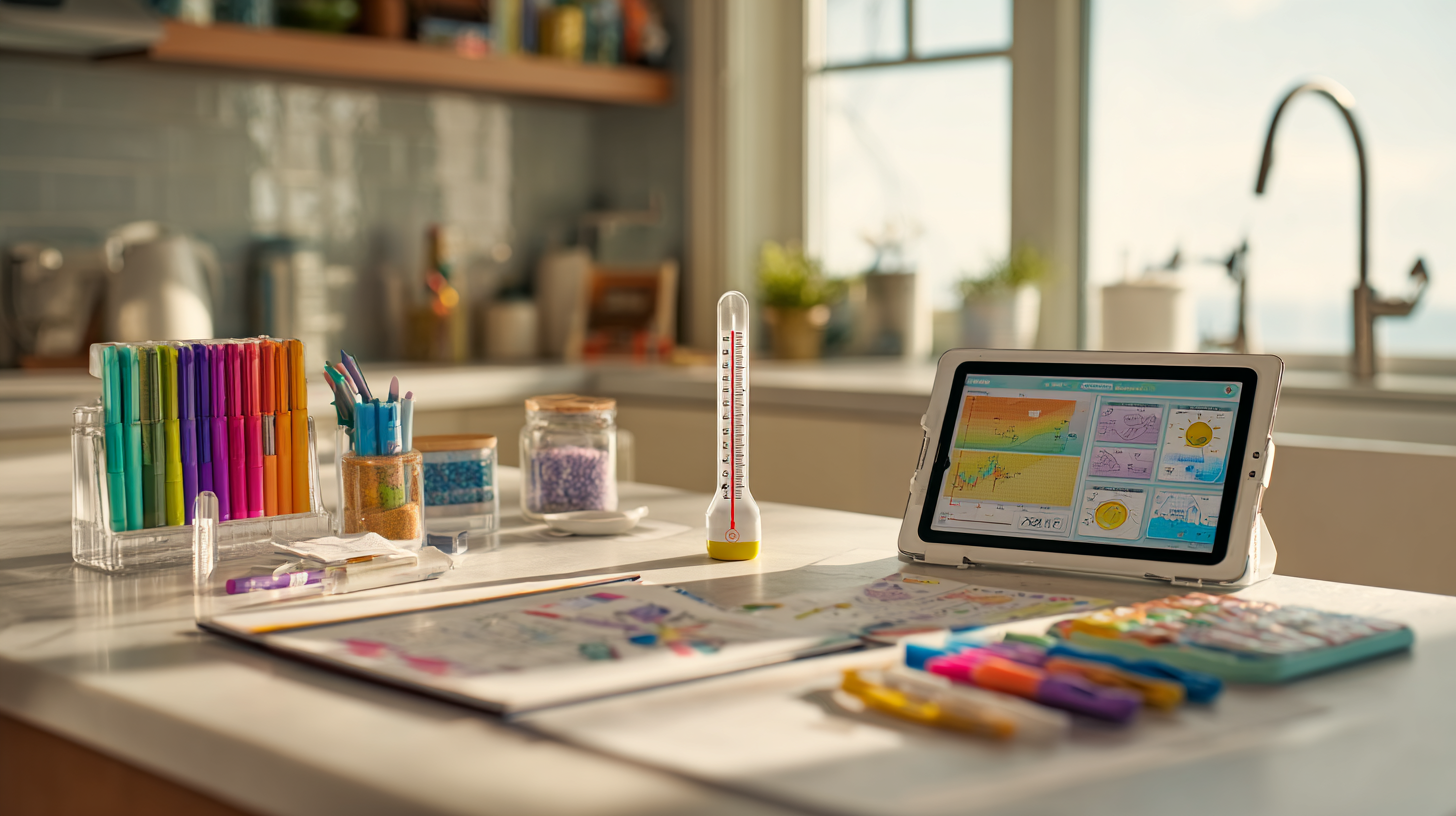
The foundation of successful morning weather temperature math starts with an accessible, inviting learning space that draws children in naturally. I’ve set up a dedicated weather station corner in our kitchen where both Jake and 4-year-old Emma can easily see and interact with temperature information throughout the day.
Our comprehensive setup includes a large digital thermometer display positioned at child height, a simple weather app on an old tablet, a colorful wall calendar for tracking daily temperatures, and a small whiteboard for quick calculations and observations. The key is making everything visual, touchable, and engaging for little hands and curious minds.
We keep colored markers specifically designated for our morning weather temperature math activities, a child-friendly calculator, counting manipulatives like colorful bears and blocks, and even a simple ruler for measuring temperature changes on our graphs. This dedicated space signals to my children that weather math is important and valued in our household.
The beauty of morning weather temperature math lies in its remarkable consistency and natural progression. Every single morning, without fail, we have brand new numbers to explore, compare, and analyze. Yesterday it was 38 degrees, today it’s 52, tomorrow might bring 61, and next week could surprise us with 70. Each day presents fresh mathematical opportunities that feel completely natural and relevant to children.
I’ve learned through trial and error that placement matters tremendously in creating successful learning habits. Our weather math station sits strategically right next to our breakfast table, making it impossible to ignore and perfectly positioned for morning conversations while the children eat their cereal and prepare for the day ahead.
The visual appeal of our station keeps children engaged and curious. We use bright colors, clear number displays, and even weather-themed decorations that change with the seasons. This creates an environment where morning weather temperature math feels exciting rather than educational or forced.
💡 Teacher Mom Tip: Start with just one thermometer and one simple question daily: “What temperature is it today?” Then gradually build complexity as your children show genuine interest and mathematical confidence. Don’t overwhelm them with too many tools or concepts at once.
Morning weather temperature math becomes incredibly engaging and educational when we transform simple observations into interactive comparison games that challenge children’s thinking. “Is today warmer or cooler than yesterday?” This foundational question alone opens up rich discussions about greater than, less than, mathematical relationships, and the fascinating concept of change over time.
We maintain a comprehensive weekly chart where both children actively record daily temperatures using different methods that match their developmental levels. Jake writes the actual numerical values while Emma draws expressive faces – happy faces for warm days, sad faces for cold days, surprised faces for extremely hot or cold temperatures, and even confused faces for those unpredictable spring days.
This visual representation system helps them understand temperature patterns, mathematical relationships, seasonal changes, and data collection in ways that feel natural and enjoyable. The chart becomes a living document of our morning weather temperature math journey that children can reference and analyze throughout the week.
Our absolute favorite comparison activity involves making educated predictions about tomorrow’s temperature based on weather patterns and mathematical reasoning. “If today is 47 degrees and the weather forecast says tomorrow will be 8 degrees warmer, what will the temperature be?” Even my 4-year-old can participate meaningfully by counting on her fingers, using our colorful counting bears, or taking physical steps to represent addition.
Temperature differences create natural, meaningful subtraction opportunities that connect abstract mathematical concepts to real-world experiences. “Yesterday was 65 degrees, today is 58 degrees. How much cooler is it today?” We use physical movements and gestures to represent these mathematical concepts – taking steps backward for decreasing temperatures, jumping forward enthusiastically for increasing ones.
The gentle competitive element keeps children engaged and motivated without creating pressure or anxiety about performance. “Who can guess closest to the actual high temperature today?” We make these predictions during breakfast conversations and check our results during dinner, creating mathematical anticipation that spans the entire day and builds analytical thinking skills.
Do you find that your children respond better to competitive elements or collaborative problem-solving approaches? I’ve discovered that mixing both styles keeps our morning weather temperature math activities fresh and engaging for different personality types and learning preferences.
💡 Teacher Mom Tip: Use your child’s age as a temperature target number for personalized learning. If they’re 8 years old, challenge them to find when the temperature might be exactly 8 degrees different from today’s reading, or identify patterns involving the number 8.
Teaching temperature conversion might initially sound advanced or overwhelming, but morning weather temperature math makes this important mathematical concept surprisingly accessible and practical for children of all ages. I start by showing both temperature readings on our weather apps – “Look, it says 70°F and also 21°C. Those are different ways to measure exactly the same temperature, just like we might measure distance in feet or meters.”
We’ve developed simple, memorable reference points that children can easily remember and apply in real situations. “32°F equals 0°C – that’s the magical temperature when water freezes into ice!” and “212°F equals 100°C – that’s when water bubbles and boils for cooking!” These concrete, relatable examples give them solid anchor points for understanding both temperature scales in practical contexts.
For elementary-age children participating in morning weather temperature math, I focus on approximation and estimation rather than complex mathematical formulas that might overwhelm or discourage them. “To go from Celsius to Fahrenheit, we can double the number and add 30 for a quick estimate.” This approach isn’t perfectly mathematically accurate, but it gives children a practical, usable method for comparing temperatures when traveling internationally or reading global weather reports.
Our engaging conversion games involve realistic, relatable scenarios that make morning weather temperature math feel relevant and useful in everyday life. “Grandma lives in Canada where they use Celsius measurements. If it’s 25°C there today, should she wear a warm coat or summer shorts when she goes outside?” These practical applications help children understand that mathematical skills have real-world value and importance.
Emma particularly loves our interactive “temperature detective” game where she has to analyze clues and guess which number represents Fahrenheit and which represents Celsius just by looking at the values and thinking logically. “Is 80 degrees pleasantly hot or dangerously freezing? What about 25 degrees?” This analytical thinking builds crucial number sense naturally and develops mathematical reasoning skills.
We extend our morning weather temperature math conversion practice into cooking activities, seasonal discussions, and even planning family vacations to different climates. This comprehensive approach helps children see mathematics as a useful tool rather than an abstract school subject.
💡 Teacher Mom Tip: Use familiar cooking temperatures as additional practice opportunities throughout the day. “The oven is set to 350°F for baking cookies. That’s about 175°C. Notice how much hotter that is than our comfortable morning temperature of 45°F!”
Visual representation transforms morning weather temperature math from abstract numerical concepts into concrete, observable patterns that children can see, touch, and thoroughly understand. We maintain a detailed line graph throughout each week, carefully plotting daily high and low temperatures while looking for interesting trends, patterns, and mathematical relationships together as a family learning team.
Our established graphing routine takes just two to three minutes each morning but provides incredible educational value and mathematical learning opportunities. Jake carefully plots the temperature points using different colored pencils while Emma colors in squares below each point, creating both a detailed line graph and a colorful bar chart simultaneously. This dual representation approach accommodates different learning styles and helps various types of learners grasp the same mathematical information effectively.
Pattern recognition emerges naturally and organically through consistent, daily graphing practice as part of our morning weather temperature math routine. “Look closely – the temperature went up steadily for three consecutive days, then dropped significantly on Thursday. Based on this pattern, what do you think will happen this weekend?” These analytical predictions engage critical thinking skills and help children understand weather as a complex, interconnected system rather than random, unrelated daily events.
We regularly compare our current graphs with data from different weeks, months, and seasons to identify larger mathematical patterns and relationships. “In January, our highest recorded temperature was only 42 degrees. In July, our lowest temperature was 78 degrees. What does this significant difference tell us about seasonal changes and climate patterns?” This long-term data collection and analysis creates meaningful, substantive mathematical conversations that extend far beyond simple number recognition.
The genuine satisfaction and sense of accomplishment that comes from completing a weekly temperature graph gives children authentic ownership over their learning process. They become personally invested in the mathematical process and often remind me enthusiastically if we’ve accidentally forgotten to record a day’s temperature. This intrinsic motivation and self-directed learning is incredibly powerful for sustained educational engagement.
Do you think your children would enjoy seeing their temperature predictions plotted against actual results throughout the week? The immediate visual feedback creates instant learning opportunities and builds mathematical confidence through concrete success experiences.
Have you noticed how children naturally gravitate toward visual learning when mathematical concepts become tangible and observable? Our morning weather temperature math graphing activities have helped both my children develop stronger analytical thinking skills that transfer to other academic subjects and real-world problem-solving situations.
💡 Teacher Mom Tip: Use different colored pencils or markers for predicted temperatures versus actual recorded temperatures on the same graph. The visual comparison becomes an instant, powerful lesson about estimation accuracy and mathematical prediction skills that children can see and understand immediately.
Morning weather temperature math reaches its full educational potential when we thoughtfully connect numerical data to practical decision-making and real-world problem-solving scenarios that children encounter in their daily lives. “It’s 38 degrees this morning but the weather forecast shows it will reach 65 degrees this afternoon. What should we wear to the playground, and should we bring extra layers for later?”
These realistic scenarios teach mathematical reasoning alongside essential practical life skills that children will use throughout their lives. Children learn to consider multiple variables simultaneously, make educated predictions based on data, and adjust their thinking based on changing information and circumstances. The mathematical learning becomes purposeful, relevant, and immediately applicable rather than abstract or theoretical.
We regularly create personalized story problems using our actual collected weather data from our morning weather temperature math activities. “If we leave for school when it’s 42 degrees and come home when it’s 58 degrees, how much warmer will it be when we return? Should we bring a jacket for the morning but leave it at school?” These customized word problems feel personally relevant and engaging because they directly relate to the children’s own experiences and daily routines.
Our innovative temperature budgeting games help children understand comfortable temperature ranges and develop practical decision-making skills. “Our house thermostat stays at 72 degrees for comfort. Outside it’s currently 45 degrees. How much warmer is it inside our house compared to outside? Why do you think we heat our house?” This naturally leads to fascinating discussions about energy use, heating costs, environmental awareness, and family budgeting concepts.
Planning daily activities becomes an exciting mathematical exercise that combines learning with practical preparation. “The community pool needs to be at least 75 degrees for comfortable swimming. It’s currently 73 degrees and rising approximately 3 degrees per hour according to the weather service. When will it be ready for our swimming plans?” Real-world problem-solving makes morning weather temperature math feel essential and valuable rather than optional or academic.
Weather-related clothing decisions provide excellent opportunities for mathematical reasoning and practical application. “The temperature will start at 50 degrees but reach 78 degrees by afternoon. How should we dress in layers to stay comfortable all day?” These discussions help children understand temperature ranges, prediction skills, and practical planning strategies.
👉 More daily math play ideas here for transforming other routine moments into valuable learning opportunities that build mathematical confidence naturally.
Transportation and activity planning become mathematical adventures through our morning weather temperature math approach. “It’s 32 degrees outside – that’s freezing temperature. What does this mean for riding bicycles safely? Should we choose indoor or outdoor activities today?” These practical applications help children understand that mathematics is a valuable tool for making safe, smart decisions.
💡 Teacher Mom Tip: Allow and encourage children to make the final decisions based on their mathematical reasoning and analysis. “You calculated that we need warm jackets this morning but lighter clothes this afternoon. Let’s follow your plan and see if your mathematical thinking was accurate!” This approach builds genuine confidence and validates their developing mathematical thinking skills.
The remarkable and lasting impact of morning weather temperature math lies in how seamlessly it integrates into natural family life while building genuine, deep-rooted mathematical confidence that extends far beyond simple number recognition. My children now automatically notice temperature changes throughout the day, make educated predictions about weather patterns, and think numerically about environmental conditions without any prompting, guidance, or reminders from me.
This educational approach works exceptionally well because it feels completely natural and organic rather than forced or artificially structured. Children don’t resist learning when mathematical concepts emerge from genuine curiosity, practical needs, and real-world applications that directly affect their daily experiences. Weather affects everyone every single day, making it the perfect, reliable vehicle for consistent mathematical exploration and discovery.
The rich, meaningful conversations we have over breakfast about temperature comparisons, pattern analysis, and weather predictions have strengthened both their fundamental number sense and their analytical thinking skills significantly. Jake recently shared our weather graphing project enthusiastically with his third-grade teacher, and she was amazed at his sophisticated understanding of data patterns, mathematical reasoning, and logical analysis that most children his age haven’t yet developed.
Even more importantly for long-term educational success, both children have developed overwhelmingly positive associations with mathematics as a subject and as a thinking tool. They see numbers as practical tools for understanding their world rather than abstract concepts to memorize for tests. This foundational attitude and mathematical confidence will serve them well throughout their entire educational journey and beyond.
The transformative impact of our morning weather temperature math routine extends far beyond basic mathematical skills and concept understanding. It has improved their observation skills dramatically, enhanced their prediction abilities, strengthened their logical reasoning, and developed their analytical thinking patterns. These transferable skills positively impact reading comprehension, science understanding, and problem-solving across all academic subjects and real-world situations.
Our weather math discussions have also strengthened family bonding time and created shared learning experiences that we all genuinely enjoy. Instead of rushing through morning routines, we now have focused, meaningful conversations that start each day with curiosity, learning, and mathematical thinking.
👉 More daily math play ideas here to continue building mathematical confidence through everyday moments and routine activities.
The long-term benefits continue to surprise me as both children apply mathematical thinking to new situations independently. They compare prices at the grocery store, estimate time for activities, and analyze patterns in their own growth and development. Morning weather temperature math has become a foundation for lifelong mathematical confidence and analytical thinking.
Have you started to see how simple daily routines can become powerful learning opportunities? The key is consistency, natural integration, and following your children’s curiosity rather than forcing formal instruction into family time.
Don’t let another morning slip by without mathematical magic and learning opportunities! Transform your daily weather check into powerful, engaging learning moments that build genuine confidence, natural curiosity, and real mathematical thinking skills that will benefit your children for years to come.
👉 More daily math play ideas here to discover dozens of other routine-based learning opportunities that make mathematics feel as natural and effortless as breathing. Start tomorrow morning with just one simple question about today’s temperature – your children’s mathematical confidence and analytical thinking skills are waiting to bloom and flourish with consistent, loving support!
What age is appropriate for starting morning weather temperature math activities with children?
Children as young as 3 can participate meaningfully in basic temperature observations and simple comparisons, while elementary-age children can handle more complex conversion problems, detailed graphing activities, and sophisticated problem-solving challenges. The key is thoughtfully adapting the complexity and expectations to match your individual child’s developmental level while maintaining the consistent daily routine that builds mathematical confidence over time.
How long should morning weather temperature math activities take each day?
Our established daily routine takes just 2-3 minutes during breakfast and feels completely natural rather than forced or time-consuming. The educational power lies in consistency and regular exposure rather than duration or intensity. Extended activities like weekly graph analysis or seasonal comparisons might take 5-10 minutes on weekends, but daily observations should feel effortless, enjoyable, and naturally integrated into your existing morning routine.
What if my child resists mathematical discussions or shows no interest in numbers during morning time?
Start with simple, casual observations rather than formal questions or structured lessons. “Wow, look how cold it is today!” gradually and naturally evolves into “Is it colder than yesterday?” over time. The key is following your individual child’s natural curiosity and interests rather than forcing structured lessons or mathematical instruction. Make conversations feel natural and fun rather than educational or instructional, and let their interest guide the complexity level.
Finger Math Strategies: Hands-On Ways Kids Learn Numbers When my 8-year-old son was in kindergarten, I watched him struggle with

Make 10 Activities: Simple Math Games Kids Enjoy Daily “Mom, can we play the finger game again?” My 4-year-old daughter

Roll-and-Add Challenges: 5 Fun Math Games Kids Love You know what’s funny? I taught high school math for fifteen years,
*Also read:
25 Brilliant LEGO Math Activities to Build Number Sense and STEM Skills at Home
Teach Kids to Tell Time: The Clock Game Every Parent Should Try at Home